








For years, being visible online largely meant appearing in search engine results pages. Businesses optimized their websites to rank for relevant keywords, attract organic clicks and build authority within traditional search engines.
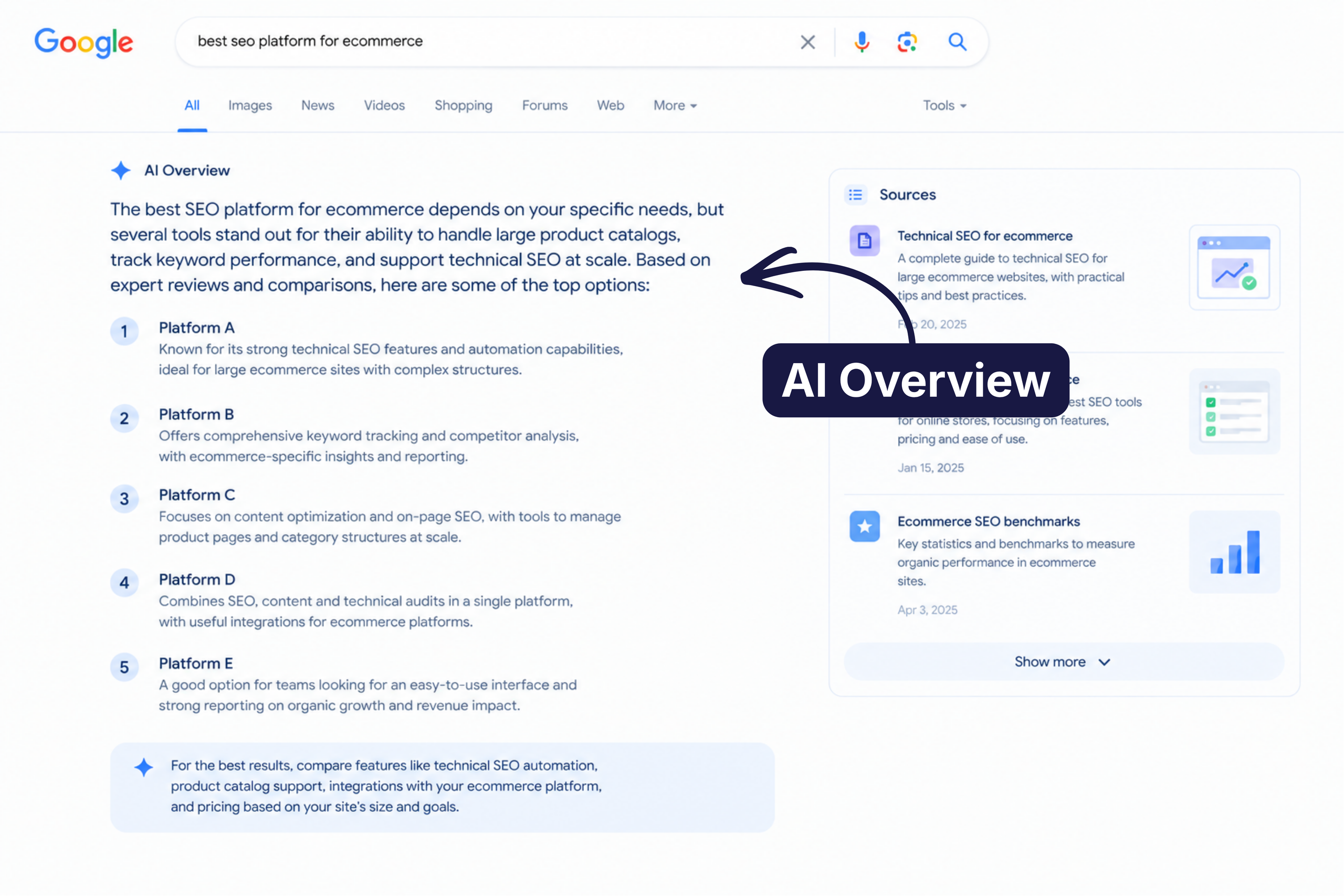
Today, users are increasingly encountering another type of search experience: AI-generated answers.
Google AI Overviews and AI Mode, ChatGPT search and other generative search experiences can interpret a query, retrieve information from multiple sources and generate a synthesized response rather than simply presenting a list of links.
The term “Generative Engine Optimization” was introduced in academic research as a framework for improving the visibility of content in generative engine responses. A 2023 study that introduced the GEO concept found that specific content optimization strategies could increase the visibility of sources in generative responses, but the effectiveness of those strategies varied across domains and generative engines.
GEO therefore describes a new visibility challenge: how can a brand’s content become a source that AI systems can discover, understand and potentially cite when generating an answer?
What is GEO?
GEO stands for Generative Engine Optimization.
It refers to the practice of improving the way content can be discovered, interpreted and represented by generative AI systems and AI-powered search experiences.
While traditional SEO is largely concerned with how search engines crawl, index and rank web pages, GEO focuses on what happens when an AI system retrieves information and uses it to construct an answer. A generative search experience produces a synthesized answer based on information retrieved from several sources, with links or citations pointing back to some of them.
The objective therefore shifts from simply ranking for a query to increasing the likelihood that a brand or page becomes part of the information used to answer it.
However, GEO should not be understood as a completely separate replacement for SEO. Google’s current guidance explicitly states that the same fundamental SEO best practices remain relevant for AI Overviews and AI Mode. Pages still need to be crawlable, indexable, technically accessible and useful to people.
In practice, GEO is better understood as an extension of search visibility into generative interfaces.
Why does GEO matter?
The reason GEO has emerged is simple: the search interface is changing. Users are increasingly asking more complex and conversational questions. Instead of performing several searches and opening multiple pages, they can ask an AI system to synthesize information for them.
This behaviour is also extending into commercial and purchasing decisions. Users can ask AI assistants such as ChatGPT about products and services, request recommendations, compare alternatives, evaluate features or prices, and ask which solution best fits their needs. In these cases, the AI-generated answer can become part of the consideration process itself, even when the user has never searched for a specific brand. Some AI platforms are now taking this a step further by enabling users to complete purchases directly within the AI interface. OpenAI’s Instant Checkout, for example, allows eligible users to buy products from participating merchants without leaving ChatGPT, while Google is introducing agentic checkout experiences within AI Mode. This means that some of the intermediate stages traditionally taking place on a brand’s website, from product discovery and comparison to consideration and checkout, can increasingly be handled within the AI experience itself.
Google describes AI Mode as particularly useful for nuanced questions, comparisons and queries that previously might have required several searches. Its systems can also use a technique called “query fan-out”, where related searches are performed across different subtopics and sources before an answer is generated.
This changes the role of the website. A page can still receive a click from a traditional search result, but it can also potentially become a supporting source within an AI-generated response.
Research from Pew Research Center illustrates how widespread these experiences have already become. In an analysis of browsing activity from 900 U.S. adults, around six in ten participants encountered a Google search page containing an AI-generated summary during March 2025.
At the same time, research into click behaviour suggests that AI-generated summaries can change the relationship between visibility and traffic. For example, an Ahrefs analysis of 300,000 keywords found that the presence of an AI Overview was associated with a 34.5% lower average click-through rate for the top-ranking page in its initial 2025 analysis. A subsequent analysis using December 2025 data reported an even larger reduction for position-one results on the informational queries studied. These are third-party studies, so their findings should be interpreted within the specific datasets and methodologies used.
How does GEO work?
Generative search systems do not simply reproduce a webpage. They retrieve information, evaluate sources and generate a response based on the information available to them. The exact processes vary between systems and are often proprietary. There is therefore no single, universal GEO algorithm.
However, generative search experiences can involve several stages:
- retrieving relevant information;
- interpreting the meaning and context of different sources;
- combining information from multiple pages;
- generating a response to the user’s query;
- providing supporting links or citations where appropriate.
Google, for example, explains that its generative search experiences can use retrieval-augmented generation, or RAG, to ground AI responses in information retrieved from its Search index.
For brands, this means that simply matching a keyword is not enough. Content needs to be understandable in context. A page that clearly explains a concept, answers a specific question, uses precise terminology and provides evidence gives AI systems more usable information to retrieve and synthesize.
GEO vs SEO: what is the difference?
SEO and GEO address different stages of the same broader visibility problem.
SEO focuses on search discoverability and rankings.
GEO focuses on visibility within generative answers and AI-powered search experiences.
| SEO | GEO |
| Optimizes for search engines | Optimizes content for generative search experiences |
| Focuses on crawling, indexing and ranking | Focuses on retrieval, interpretation and representation |
| Often measured through rankings, impressions and organic traffic | Can also be measured through mentions, citations and inclusion in AI-generated responses |
| Targets traditional search results | Targets AI Overviews, AI Mode and conversational search experiences |
But the two approaches increasingly overlap. Google’s own documentation makes this particularly clear: there are no additional technical requirements specifically for appearing in AI Overviews or AI Mode beyond being eligible to appear in Google Search.
GEO should therefore not be treated as a completely separate discipline. It is better understood as an additional layer of search visibility built on strong SEO foundations.
What makes content more visible to generative engines?
There is no guaranteed formula for appearing in an AI-generated answer. Generative systems differ in how they retrieve, evaluate and synthesize information, and their underlying models continue to evolve.
However, several principles are particularly relevant.
Clear structure makes content easier to understand. Descriptive headings, logical sections and clearly defined concepts help communicate what a page is about and which questions it answers.
Strong topical relevance is equally important. Rather than creating separate pages for every variation of a query, it is often more useful to build comprehensive content around a genuine topic and its related questions.
Original and useful information can also make content more valuable as a source. Original research, proprietary data, first-hand experience, expert explanations and clearly attributed evidence give a page something distinctive to contribute.
Finally, technical accessibility remains essential. Before content can be retrieved and understood, it needs to be accessible to search engines and AI crawlers. For ChatGPT Search specifically, OpenAI states that websites should allow OAI-SearchBot to crawl their content if they want to be eligible for inclusion in ChatGPT search results.
Branded vs unbranded queries
One of the most useful ways to understand GEO is to distinguish between branded and unbranded queries.
A branded query explicitly mentions a company, product or brand, such as “Kleecks SEO platform” or “Kleecks pricing”. An unbranded query refers instead to a problem, category or solution without naming a specific brand, such as “best technical SEO platform” or “how to improve website performance”.
The distinction matters because these queries represent different stages of the search journey. When a user searches for Kleecks directly, the brand is already known. When a user searches for “best technical SEO platform”, they may be discovering the category and evaluating different options.
This creates two different GEO objectives. Branded GEO is about ensuring that AI systems understand and represent your brand accurately, while unbranded GEO is about making your brand relevant to users who are searching for a solution without knowing which brand they want.
This is particularly important for discovery. If an AI-generated answer to a generic query mentions your brand, you have entered the user’s consideration set before they have actively searched for you.
GEO therefore requires a broader approach to keywords. Generative search is designed to handle conversational and complex questions, so the exact wording of a query is only part of the picture. A user might search for “best SEO platforms”, then ask which ones are suitable for ecommerce and finally which platform can automate technical SEO. These queries are different, but they belong to the same decision journey.
This is why GEO strategies should consider topics, entities and search intent, rather than focusing exclusively on individual keywords.
Query fan-out and generative search
This becomes even more relevant because generative search systems can break a complex prompt into several related searches before producing an answer.
Google describes this process as query fan-out. A query such as “What is the best SEO platform for a large ecommerce company?” may require the system to investigate ecommerce SEO, technical SEO automation, scalability, integrations and competing platforms before generating a response.
The implication is important: brands are not necessarily competing only for the query users type. They are competing across the broader semantic territory that an AI system may explore to answer that query.
This is why topical relevance and consistent information about a brand matter. The relationship between a brand and concepts such as technical SEO, automation, ecommerce or website performance should be clear across its own website and relevant third-party sources.
How should GEO visibility be measured?
Traditional SEO focuses on metrics such as rankings, impressions, clicks, CTR and organic traffic. GEO introduces additional dimensions, including AI mentions, citations, branded visibility and unbranded visibility.
These metrics answer different questions: Is the brand mentioned when users search for it directly? Does it appear when users search for a category or problem? Is its website cited as a source? Which competitors appear in the same answers?
A brand could have strong branded visibility while remaining almost invisible for unbranded queries. Conversely, it could be frequently mentioned in generic answers without generating significant website traffic.
This means that GEO can be viewed as an extension of the search funnel:
Query → Retrieval → Source selection → AI-generated answer → Mention or citation → Click or consideration
The website remains central to this process. Technical accessibility, clear information architecture, useful content and strong topical relevance are still fundamental. GEO adds another layer by asking whether that information can also be retrieved, understood and represented within an AI-generated answer.
Building visibility for the next generation of search
Search is evolving from a model based primarily on finding pages toward one that increasingly combines finding, understanding and synthesizing information.
This does not make traditional SEO obsolete. It makes its foundations even more important. Technical accessibility, useful content, clear structure, authority and relevance remain essential, while GEO adds another perspective on how this information can be used within generative search experiences.
SEO helps your website become discoverable. GEO helps you think about how that information can become part of the answer.
For brands, the opportunity is therefore broader than simply winning a position in the SERP. It is about building a digital presence that search engines and AI systems can find, understand and confidently use.
This is particularly relevant as users increasingly turn to AI assistants such as ChatGPT to research products, compare alternatives and make purchasing decisions. In these interactions, a brand’s visibility can influence the consideration process even when the user never reaches a traditional search results page.
This is where Kleecks can help. Alongside automating SEO optimization, Kleecks’ AI Search Audit module analyzes how well your website performs across the queries users are asking and for which AI systems generate answers and cite sources. It helps you understand where your brand appears, where it is missing and how your website performs within the evolving landscape of generative search.
As GEO becomes an increasingly important part of search visibility, Kleecks combines automated SEO optimization with the tools needed to identify and address the new challenges of AI-powered search.
Curious to decode more digital marketing acronyms? Read our article where we break them all down: “acronyms you need to know and why they matte https://www.kleecks.com/digital-marketing-acronyms/
Moreover, if you want to discover how Kleecks’ platform can help you optimize your website, check our Product Corner series.