







The basics you need in 2026
Your potential customer has an event coming up and needs a pair of elegant shoes. They open Google and search for “comfortable heels for formal occasions”.
What happens next is something we all experience every day, but rarely stop to fully understand. If you want your customer to buy from you, you need to understand how online search works, how it is evolving, and why manually managing it is more complex than it might seem.
The search engine, whether Google, Bing, or others, returns what is called a SERP (Search Engine Results Page). Inside this page, different elements compete for attention at the same time: ads, organic websites, AI-generated summaries, and other enhanced results.
This is where most digital marketing actually takes place.
In this article, we break down the essential acronyms you need to understand to navigate and compete in digital marketing in 2026.
SERP: Search Engine Results Page
The SERP is the page that appears after a user enters a query into a search engine.
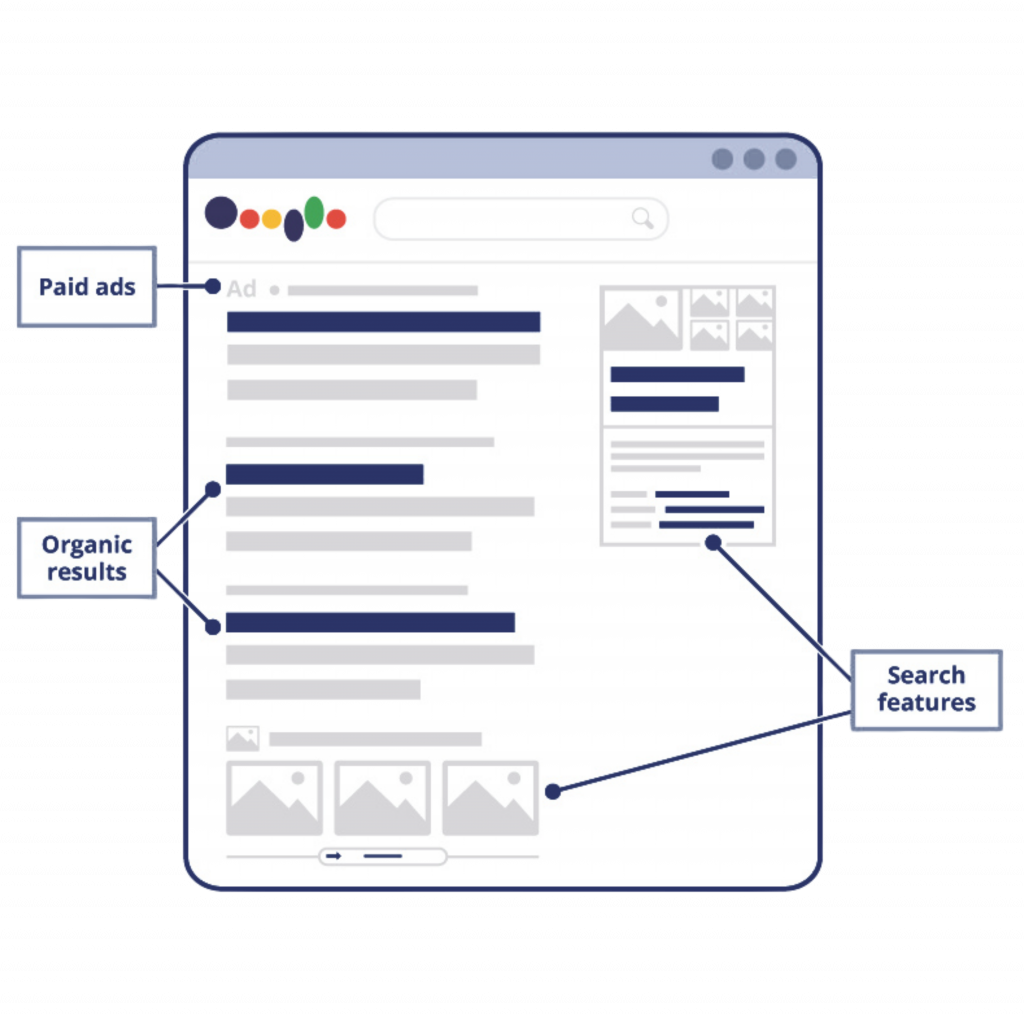
It is not simply a list of links. It is a structured environment where different types of content coexist and compete for visibility. These include:
- paid ads,
- organic results,
- rich features such as maps or shopping modules,
- and increasingly AI-generated answers.
Each element competes for the same resource: user attention. For this reason, the SERP should not be seen as a neutral container, but as a system that actively shapes what users see first and what they are more likely to ignore.
CTR: Click-Through Rate
Once a user is on the SERP, they make a decision about where to click.
CTR, or Click-Through Rate, measures how many users click on a specific result after seeing it. The more complete, and informative the results, also known as snippet, the more they stand out within the SERP
A higher position in the results usually increases visibility, but it does not guarantee clicks. In the same way, clicks themselves do not always reflect meaningful engagement.
CTR is therefore a key metric to understand how effectively a result captures attention in a competitive environment where multiple options are presented at the same time.
CRO: Conversion Rate Optimization
After clicking on a result, the user lands on a website and takes the next step. This is where CRO, or Conversion Rate Optimization, becomes relevant.
CRO focuses on improving the percentage of users who complete a desired action (Conversion Rate), such as:
- making a purchase
- signing up
- completing a journey on the site
Traffic alone does not create much value. What matters is how effectively it is converted into meaningful actions.
CRO connects visibility with business outcomes and helps evaluate whether user journeys are working as intended.
SEO, SEA/SEM, and GEO: three ways of being visible
In theory, SEM (Search Engine Marketing) is the broader term that includes all search marketing activities, including both SEO and SEA, while SEA refers specifically to paid search.
Search visibility mainly comes from two primary sources: Search Engine Optimization and Search Engine Advertising.
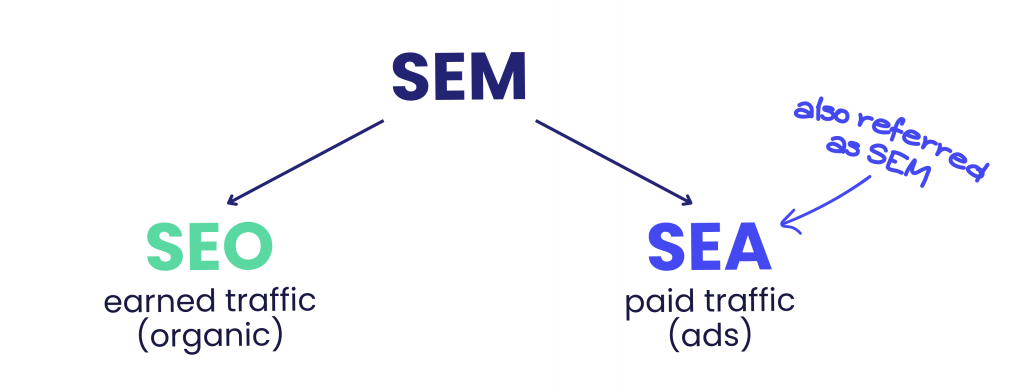
However, in practice, SEA is rarely used as a standalone term, and SEM is more commonly used to refer specifically to paid search activities.
Alongside these, GEO is becoming increasingly important. As a result, some people claim that SEO is dead and being replaced by GEO, but that isn’t actually true (at least not yet).
SEO: Search Engine Optimization
SEO, or Search Engine Optimization, refers to the process of appearing in organic search results. It does not involve direct payment for placement. Instead, visibility is earned through content relevance, quality, technical performance, and authority.
Key elements of SEO include:
- on-page structure such as content, headings, and internal linking
- off-page signals such as backlinks and external authority
SEO is what allows websites to build long-term visibility and attract users who are actively searching for specific information, products, or services.
According to research, the first result in Google’s organic search results has an average click-through rate of 27.6%, compared to 18.7% for the second position and 10.2% for the third. Together, the top three results account for around 60% of all clicks. Reaching these positions, or even just appearing on the first page of Google’s SERP, leads to more traffic and more opportunities to convert prospects into customers.
Summing up, SEO impacts a page’s visibility, its authority (i.e., how trustworthy and relevant it is as a source of information), and the overall customer experience for every user or potential prospect.
SEM/SEA: Search Engine Marketing & Search Engine Advertising
SEM refers to paid visibility in search engines, typically implemented through auction-based advertising systems such as Google Ads.
Advertisers bid on keywords and pay for impressions or clicks, depending on the campaign model. This allows for immediate visibility and precise targeting based on intent, geography, and demographics.
While SEA would technically be the correct term for paid search, in practice SEM is more commonly used to describe this entire paid search activity.
Key characteristics of paid search include:
- immediate visibility in search results
- full control over targeting and messaging
- strong measurability and optimization potential
- direct dependency on budget (visibility stops when spending stops)
Paid search is often used for acquisition campaigns, product launches, and performance testing, while SEO supports long-term growth and compounding returns.
In many digital strategies, SEO and SEM work together: SEO builds sustainable traffic over time, while SEM provides scalable and immediate demand capture.
However, it is generally not recommended to rely heavily on SEM without first having a solid SEO foundation in place, as paid search can drive traffic quickly but does not compensate for the lack of organic visibility, content authority, or long-term search presence.
GEO: Generative Engine Optimization
Search behaviour is changing with the introduction of AI-powered systems.
Recent studies show that a growing share of search interactions is shifting toward AI-generated answers rather than traditional link-based results. Around 7 out of 10 searches now end without a click, as users find answers directly on the results page or in other zero-click environments. Instead of scrolling through lists of links, users increasingly receive direct, AI-generated summaries that combine information from multiple sources, often engaging with just 1–3 embedded references rather than exploring full SERPs. In parallel, many users are also bypassing traditional search engines altogether by turning to LLM-based chatbots such as ChatGPT to obtain direct, conversational answers.
At the same time, traditional search behaviour is still dominant: despite AI growth, over 80% of global search traffic is still routed through classic search engine result pages, meaning GEO is emerging as a complementary layer rather than a replacement for SEO.
This is where GEO, or Generative Engine Optimization, becomes relevant.
GEO focuses on making content understandable and usable for AI systems so that it can be interpreted correctly, selected as a source, and included in generated responses.
Academic research on generative engine optimization shows that structured, well-cited, and semantically clear content can significantly improve inclusion in AI-generated answers, in some experimental settings by up to ~40%, depending on query type and domain.
The goal is no longer limited to appearing in search results, but extends to becoming part of the answer itself.
Why this matters in 2026
Digital discovery is no longer limited to traditional search engines. It now spans across search platforms, AI systems, and hybrid interfaces that combine both.
As a result, visibility depends on multiple layers working together rather than a single channel.
Understanding these fundamentals is essential to remain competitive in a landscape that is evolving quickly.
Where Kleecks fits in
As this system becomes more complex, managing visibility manually becomes increasingly difficult to scale.
Today, visibility depends not only on creating content or selecting keywords, but on how content is structured, interpreted by machines, and connected across an entire website.
Many teams rely on AI tools to generate content or identify opportunities. However, without a strong technical foundation, this approach often reaches its limits.
Content that is not properly structured, semantically consistent, and technically optimized is harder for search engines and AI systems to interpret and retrieve.
Search engines and generative engines do not simply read content. They process it and extract meaning from its structure and relationships.
This is why elements such as
- structured data
- internal linking
- performance
- indexing
- content hierarchy
play a critical role in modern visibility.
These signals help systems understand context, evaluate reliability, and decide what content can be surfaced.
AI Search Audit is a platform designed to analyze how AI systems interpret a website and how prepared it is for AI-driven search experiences. It identifies gaps in content structure, semantic clarity, technical SEO, and overall AI-readability, providing actionable recommendations to improve visibility in both traditional search engines and AI answer engines such as ChatGPT-style systems and AI Overviews.
Kleecks focuses on strengthening these foundations by improving technical SEO, site performance, and content structure. The goal is to make visibility more stable and scalable across both traditional search engines and AI-driven discovery systems.
You can understand Kleecks’ main features here!