








When talking about visibility on search engines, one term often creates confusion: SEM.
SEM stands for Search Engine Marketing, but its meaning varies across the industry. The Digital Marketing Institute uses SEM as a broad term for marketing through search engines, including both SEO and paid methods such as PPC. It defines SEA, Search Engine Advertising, more specifically as the practice of displaying paid advertisements on search engine results pages.
In other words, we can think of SEM as the broader search marketing ecosystem, inside which SEO and SEA represent two different approaches to gaining visibility. This distinction matters because paid visibility is only one part of a successful search strategy.
What is SEA?
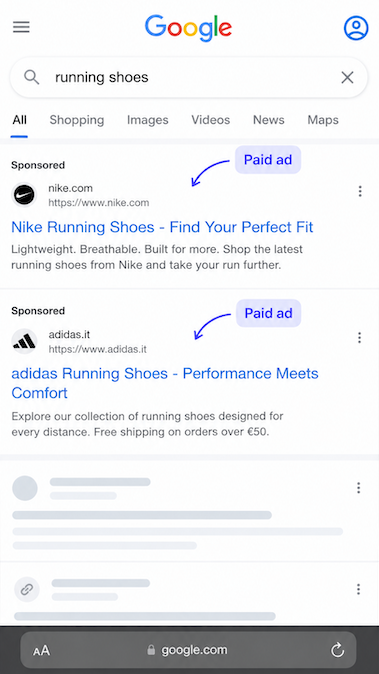
SEA refers to paid advertising on search engines: it allows businesses to promote their products, services or content when users perform relevant searches.
On Google, for example, paid search works through an auction system. Every time a user performs a search, eligible ads enter an auction that determines whether they can appear and where. The outcome depends on several factors, including the bid, ad and landing-page quality, competition and the context of the search.
This makes SEA particularly useful for reaching users at specific moments of intent. Advertisers can work with keywords, audiences, locations, devices and other signals to decide where and when their ads should compete for attention.
SEA therefore offers something valuable: speed and control.
A business launching a new product, promoting a seasonal offer or trying to generate traffic for a specific service can activate paid visibility without waiting for organic rankings to develop.
What makes SEA useful?
The main strength of SEA is its ability to capture existing demand.
If someone searches for “running shoes”, “CRM software” or “SEO platform”, they are already expressing an interest in a category, product or solution. A paid ad can put a relevant brand in front of that user at that precise moment.
SEA can therefore help businesses:
- increase visibility for relevant searches;
- capture high-intent traffic;
- support product launches and campaigns;
- test keywords and messaging;
- generate data about search behaviour.
That last point is particularly valuable. Paid campaigns can reveal which queries attract attention, which messages generate clicks and which audiences are more likely to engage.
But these advantages should be seen in context.
SEA can accelerate visibility. It does not replace the need to build it.
Why SEA alone is not enough
A click is not the end of the search journey, but rather the beginning of a potential interaction with your website.
Google itself makes this clear in its advertising system. Ad Rank considers the quality and relevance of the landing page, including whether it meets user expectations and is easy to navigate. Google also states that higher-quality ads can achieve better performance, including better positions and potentially lower costs.
So even when SEA successfully brings a user to your website, the website still has to deliver.
If the page is slow, difficult to navigate, poorly structured or irrelevant to the user’s intent, paid traffic may simply become expensive traffic. This is why search performance cannot be reduced to the number of clicks generated by an advertising campaign. The quality of the destination matters just as much.
And this is where SEO becomes increasingly important.
SEA and SEO: two different paths to visibility
SEA and SEO operate differently, but they ultimately compete for attention within the same search environment. While SEA buys visibility, SEO builds it.
SEA can provide immediate exposure for selected searches, but that visibility is directly linked to advertising investment. Once a campaign stops, its paid placements stop as well.
SEO follows a different logic. It focuses on making a website more relevant, accessible and authoritative so that search engines can understand it and users can discover it organically. The value of SEO lies precisely in building an asset that can continue to generate discoverability and qualified organic traffic over time, rather than depending entirely on continuous media spend.
That makes SEO particularly important for brands that want to strengthen their presence across the search journey.
Organic discovery matters
There is another reason why SEO deserves a central role in search strategy: not every valuable interaction begins with an advertisement.
Users may search directly for a brand, product, problem or solution and discover a website through organic results. In these situations, the brand is being found because its content or website is relevant to the search, rather than because it has purchased a placement. This organic discoverability can support the entire customer journey: from discovering a brand for the first time to finding a specific product or piece of information. And once users arrive, website performance matters again.
SEO and website performance are therefore deeply connected. Technical foundations, site structure, content and user experience all contribute to making a website easier for search engines to understand and easier for users to navigate.
So, where does SEA fit?
SEA has a clear role in a broader search strategy.
It can help brands capture demand now, test opportunities and gather insights. SEO, meanwhile, works to build the underlying organic visibility that can support long-term growth. The two can therefore complement each other.
For example, insights from paid campaigns can help identify valuable search terms or user needs. Those insights can then inform content and SEO priorities. At the same time, strong organic visibility can reduce the need to rely exclusively on paid traffic for every relevant search.
Building visibility that lasts
Search marketing is ultimately about more than appearing at the top of a results page. It is about being discoverable when users are looking for you, relevant to what they are searching for, and ready to deliver a strong experience once they arrive.
SEA can help create immediate visibility, but sustainable search growth requires something deeper: a website that search engines can understand, users can navigate and businesses can continuously improve.
That is where SEO becomes central. SEA can help you be visible today. SEO helps you build visibility that lasts.
And for brands looking at search as a long-term growth channel, that distinction matters.
Curious to decode more digital marketing acronyms? Read our article where we break them all down: “acronyms you need to know and why they matte https://www.kleecks.com/digital-marketing-acronyms/
Moreover, if you want to discover how Kleecks’ platform can help you optimize your website, check our Product Corner series.